You Spotted “HTN” on a Chart. Here’s What It Actually Means
It’s 9pm, you’re holding your dad’s discharge paperwork under the kitchen light, and there it is in the “past medical history” box: HTN. No explanation, no expansion, just three capital letters sitting next to his name like they’re supposed to mean something to you. Here’s the short version so you can put your phone down and get some sleep: HTN is medical shorthand for hypertension, which is the clinical name for high blood pressure. HTN is the three-letter version of the same diagnosis, the kind of tag a clinician clicks into a problem list a dozen times a shift because typing “hypertension” out in full gets old fast.
I know the instinct, because I’ve done the same Google-at-9pm thing over a lab report header once and half-convinced myself of something dramatic before I found out it was routine. So let’s actually walk through this one properly: what HTN means, where you’ll keep bumping into it, what the number underneath it does and doesn’t tell you, and when three letters on a page are worth an actual phone call versus just filing away.
What does HTN mean on a medical chart?
HTN stands for hypertension, and hypertension is just the medical word for blood pressure that runs consistently higher than what’s considered typical. Nothing more, nothing less. You’ll see it written as a standalone note (“HTN”), as part of a running list (“HTN, hyperlipidemia, GERD”), or tucked into a sentence like “patient has a history of HTN, well controlled on medication.”
The letters themselves don’t tell you how high, how long, how serious, or how it’s being managed. A chart that says “HTN” could belong to someone whose blood pressure runs a little high and is managed with a daily walk and less takeout, or to someone on three medications with a cardiologist on speed dial. The abbreviation flattens all of that into one shorthand tag, which is efficient for the person charting and mildly maddening for the person trying to read it cold off a printout.
Why do doctors and nurses shorten hypertension to HTN in the first place?
Medical charting has run on abbreviation for about as long as there’s been medical charting. Part of it is genuinely practical: a nurse documenting a dozen patients per shift doesn’t have time to write “hypertension” longhand every time it needs to appear, and a lot of electronic health record systems have HTN baked in as a clickable option in a problem list, not free text at all. Part of it is just professional habit, the same way anyone in a fast-moving job develops their own shorthand. I do the same thing in my notes app: “ped appt Thurs, ask re: growth chart” means something specific to me and would mean nothing to a stranger.
The catch is that this shorthand was built for other clinicians to read quickly, not for patients or family members to decode on a phone at night. Hospitals and practices run on dozens of these condensed labels for common conditions, and HTN is one of the most frequent ones you’ll run into simply because high blood pressure is so common. If you want the fuller alphabet soup, the complete guide to medical abbreviations breaks down the rest of the shorthand you’re likely to see stacked next to it on the same page.
Where will you actually run into HTN?
In practice, HTN tends to show up in a handful of predictable spots, and knowing which one you’re looking at changes how much weight to give it.
- Hospital discharge summaries. The “past medical history” or “problem list” section near the top usually lists every condition on file, active or managed, HTN included, whether or not it had anything to do with why the person was admitted.
- Family history intake forms. New patient? First appointment with a specialist? You’ve probably filled in a grid where a relative’s row just says “HTN” because that’s faster to write than “high blood pressure” six times for six family members.
- Insurance explanation of benefits (EOB) paperwork. Billing codes and their shorthand descriptions sometimes carry HTN as a listed diagnosis tied to a visit, since an EOB exists to show the insurer how a claim was coded and priced.
- Problem lists inside your own patient portal. Most portals show a running “active problems” list pulled straight from your chart, and once a clinician has documented hypertension, it tends to stay listed there as ongoing.
- Lab report headers. Some lab orders include a brief clinical reason for the test, and “HTN” as a stated reason just means the test was ordered in the context of managing blood pressure, not that the results themselves were abnormal.
Notice that only one of those (the discharge summary, sometimes) is really about an acute moment. The rest are administrative or historical. A lot of the 9pm panic comes from not knowing which bucket you’re looking at.
Is HTN just another way of saying “high blood pressure”?
Yes, fully interchangeable. There’s no clinical distinction between “HTN” and “high blood pressure” the way there sometimes is between similar-sounding medical terms. It’s purely a difference of formality and length, the same way “photo” and “photograph” mean the same thing in different contexts.
Here’s the part that actually explains why you keep seeing it: hypertension gets logged under a standardized diagnosis code, and that code rides along with the claim wherever it goes. The discharge summary from the hospital, the statement from your insurance company, and the lab slip from a completely different office are usually typed up by three different people on three different systems, none of them coordinating with each other. They’re all just pulling the same code off the same claim. So if you’re standing at the kitchen table sorting a stack of mail and “HTN” is staring up at you from an EOB, a bill, and a chart printout, all three are the same code showing up three times.
What numbers tend to get labeled HTN?
This is where I want to be careful, because exact cutoffs get argued over and updated, and a chart abbreviation doesn’t come with the math attached. In broad terms, blood pressure is recorded as two numbers: systolic (the pressure when your heart beats) over diastolic (the pressure between beats). The American Heart Association’s guidelines are the most commonly cited benchmark here, and they generally place hypertension starting around a systolic reading of 130 or a diastolic reading of 80, with “elevated” as a category just below that line.
But here’s the honest caveat: where exactly that line sits, and whether a single high reading even counts, depends on who’s measuring, how many readings were taken, what device was used, and what else is going on with the patient that day. A reading taken during a stressful ER visit isn’t treated the same way as an average of readings taken at home over two weeks. If you want to sit with the systolic number specifically and what it’s doing on its own, a closer look at what SBP means on its own covers that side of the picture in more depth than I can do justice to here.
If HTN shows up in your own chart, what does that actually mean day to day?
Take a breath first. HTN on your own chart is a label a clinician applied based on readings they took: a diagnosis with a date stamped on it, separate from anything about who you are as a person. Your Saturday plans can stay exactly as they are tomorrow; nothing about tonight changed just because you finally read the letters correctly. The practical next step is a real conversation with your primary care physician, the kind of conversation a search bar at 9pm was never going to give you.
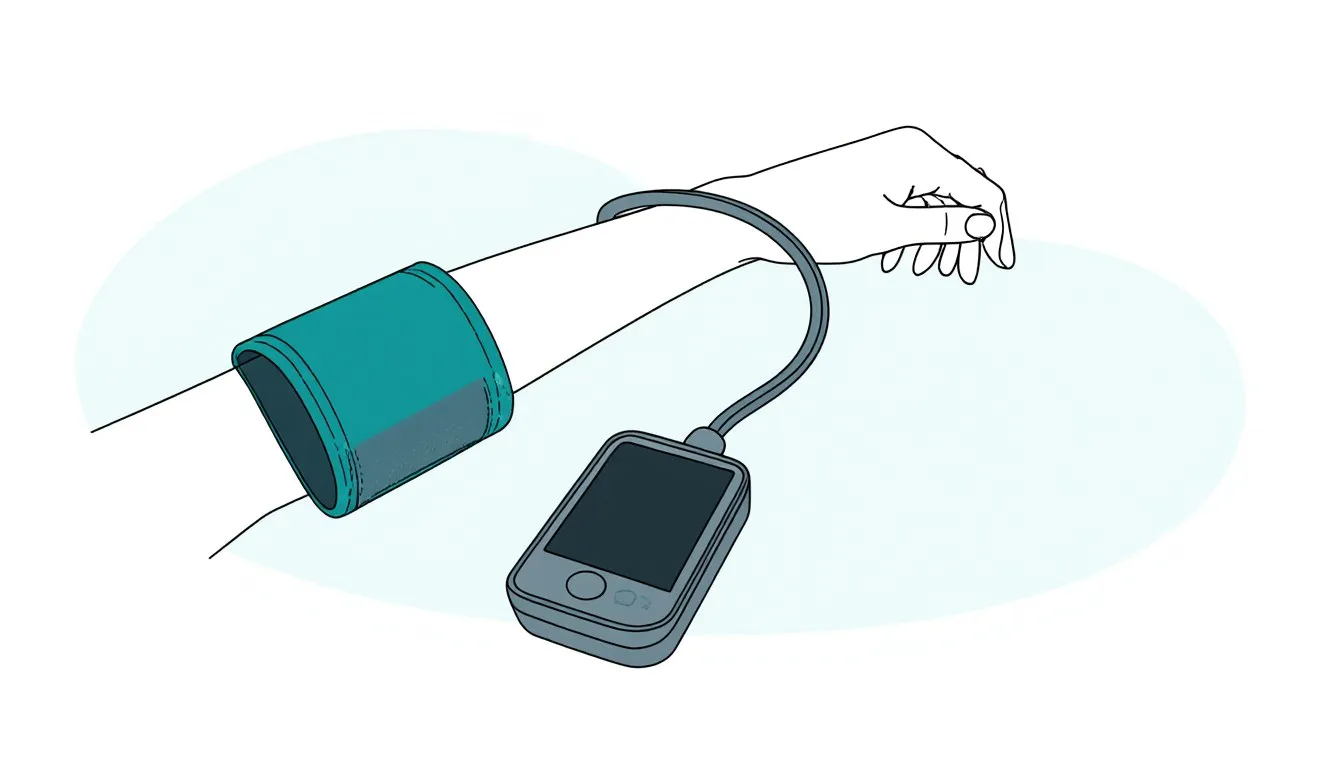
A lot of people find it genuinely useful to start tracking readings at home for a couple of weeks before that appointment, because a chart note based on one office visit reading tells a clinician a lot less than a pattern does. If you’ve got a home cuff (or access to a pharmacy one), a simple log like this is honestly more useful to bring to an appointment than a vague “it’s been kind of high lately”:
| Date | Time | Reading | Notes |
|---|---|---|---|
| e.g. 8/12 | Morning, before coffee | 128/82 | Slept badly |
| e.g. 8/12 | Evening, after dinner | 131/84 | Normal day |
You don’t need anything fancier than a notebook or the notes app on your phone for that, same two columns, a couple weeks of entries. It turns “I think it’s been high” into something your doctor can actually work with.
What everyday habits are most often linked to blood pressure?
I’m going to stay firmly in general-wellness territory here, because I’m not your doctor and blood pressure management is genuinely individual. But there’s a short list of habits that keep coming up across mainstream health guidance, and none of them require a $400 wellness overhaul.
- Sodium awareness. Cutting back matters more than cutting it out completely; the CDC and AHA both point to lower sodium intake as one of the more consistently cited habits, which in real life usually looks like cooking more meals at home and reading labels on the sneaky ones (canned soup, deli meat, bread, believe it or not).
- Regular movement. This doesn’t mean a gym membership. A 20 to 30 minute walk most days is the version that shows up again and again in general guidance, and it’s the one I’d actually tell a tired friend to try first.
- Sleep. Poor or inconsistent sleep is commonly linked to blood pressure patterns, which, if you’re a parent of a toddler, is either validating or infuriating depending on the day.
- Stress management, in whatever unglamorous form actually works for you, not necessarily meditation apps if that’s not your thing.
- Alcohol moderation. Lower intake is widely cited as a supportive habit, with guidance generally landing on moderation rather than a hard number that applies to everyone.
None of these are a prescription, and none of them are a substitute for whatever your provider actually recommends for your specific numbers. They’re just the habits that show up most often in general wellness guidance, the ones commonly linked to blood pressure, since none of them promise a fix on their own.
Does it matter which abbreviations show up next to HTN?
Yes: the company HTN keeps on the page tells you how central blood pressure is to that person’s overall picture. Flip through a real chart and you’ll usually see it bunched with other shorthand: “HTN, DM2, hyperlipidemia” is an extremely common trio, or “HTN, CAD, h/o MI” on someone with a more involved cardiac history. A solo “HTN” on an otherwise short problem list usually just means blood pressure, on its own, is being tracked. That same “HTN” wedged into a five-condition cluster with diabetes and coronary artery disease is describing someone whose cardiovascular risk factors are stacking up together, which is exactly the kind of pattern a cardiologist reads at a glance.
That’s worth knowing because it changes how you read everything else on the page. I get it if a five-item list makes your stomach drop more than a solo “HTN” would; seeing a parent’s conditions stacked up like that in black and white does that to people. In plain terms, those conditions are almost certainly being managed together already, one cardiologist or primary care doctor watching how the blood pressure medication interacts with the diabetes medication and the cholesterol numbers, instead of three separate providers working from three separate scripts. The list looks more serious stacked up on the page, but that seriousness was already there before you read it tonight; the printout is just showing it to you in one place. One concrete thing to do with that: at the next appointment, ask who’s actually coordinating the list. If nobody has a clear answer, that’s worth raising.
When is HTN on a chart actually worth a call to your doctor?
Here’s the reassuring part, and the part I actually want you to remember after you close this tab. Most of the time, HTN sitting quietly in a family history form or an old problem list is routine documentation from a visit that’s long over, and it doesn’t need a same-night phone call.
A call to your doctor’s office is worth making when:
- HTN appears on your own chart for the first time and nobody’s actually discussed it with you yet.
- Home readings show a real jump from your usual pattern, not just one odd reading on a bad day.
One situation skips the phone tree entirely: a high reading with chest pain, shortness of breath, vision changes, severe headache, weakness, or trouble speaking is an emergency. Call 911 or get to the nearest emergency department. Don’t wait for an appointment.
What generally doesn’t need urgent action: HTN listed as part of a relative’s history on an intake form, or an old, already-managed note sitting in a discharge summary from a visit that had nothing to do with blood pressure. Both of those are just paperwork catching up with something already known and already handled.
Quick answers: HTN abbreviation FAQ
Is HTN the same as high blood pressure?
Yes, completely interchangeable, you’re not missing some secret distinction. HTN and high blood pressure (hypertension) are the exact same thing, just written two different ways depending on whether the document is formal shorthand or plain English.
What does HTN mean on a medical bill or EOB?
It means hypertension is sitting on your ongoing chart, and this particular bill or claim pulled it in because it’s part of your standing record. Most of the time it has nothing to do with what happened at that specific appointment. Annoying way to find that out, I know.
My mom listed HTN on my family history intake form. Does that mean I have it too?
No, and take a breath, this one trips people up constantly. It just means she does, and the clinic wants that noted because family history is one factor providers consider. It goes in your record as background information, nothing about her diagnosis becomes yours just because it’s written on your form.
Can HTN be removed from a chart once it’s listed?
That’s a conversation for your provider, since it depends on their documentation practices and your actual health history. Not something to DIY through a portal message, however tempting that little edit icon looks.
Is HBP the same abbreviation as HTN?
They mean the same underlying condition, high blood pressure, but HTN (hypertension) is the more standard clinical abbreviation you’ll see on charts, while HBP shows up more in patient-facing materials, the kind written for someone reading it at 9pm like you.
Strip away the shorthand and what’s left is this: those three letters just mean a clinician logged hypertension on your chart on a given day, plain documentation and nothing more dramatic than that. Before you read too much into (or too little into) anything sitting in your own chart, pull out a notebook or your notes app and start the two-week home-reading log described above, then bring it to that appointment. This is general wellness information, not medical advice. Talk to a healthcare professional about your specific situation.
Maya Ellison
Staff Writer
Maya Ellison writes about living a little better on an ordinary budget and an ordinary schedule: the small, doable changes that actually stick. She is a fan of the 20-minute version of everything and deeply suspicious of any wellness plan that requires a spare $400.