What a Lily Actually Means (Beyond the Funeral Arrangement)
You’re standing at the flower shop, phone in one hand, and your finger hovers right over the lilies before it moves on to something safer. Most of us do this without even clocking it. Lilies get mentally filed under “funeral flowers” somewhere around age twelve, usually after a service where they were banked up by the dozen. That association just sticks. It’s a shame, because it means a genuinely gorgeous, genuinely meaningful flower gets skipped for birthdays, new babies, and “just because” bouquets it would actually suit beautifully. A lily’s core meaning is purity, renewal, and devotion, and depending on the variety and color, it can also say celebration, motherhood, confidence, or romantic love. Funerals borrowed one meaning, purity restored after loss, and let that single use crowd out everything else this flower says: celebration, motherhood, confidence, romantic love. Let’s get into the rest of it.
Why do lilies feel like a “serious” flower to give someone?
There’s a reason your instinct pulls back. White lilies, specifically, are a staple at funerals and memorial services across a lot of Western cultures, and that repeated exposure trains your brain to read “lily” as “loss.” It’s the same mental shortcut that makes you associate a certain jingle with a certain pizza chain. Enough banked-up white blooms at enough services, and an entire culture learned to read “lily” as loss before it ever learned that the same flower also means purity, renewal, and devotion.
Here’s the thing worth sitting with: lilies are used at funerals precisely because their meaning is so hopeful. At a funeral, the flower stands for the soul’s return to peace, purity restored after loss. That’s a beautiful sentiment for a memorial, but it’s just as fitting at a wedding, a christening, or on your own kitchen windowsill. If you’ve been avoiding lilies for anything but sympathy arrangements, I’d gently push you to reconsider. You’ve just been reading half the message.
What does a lily actually symbolize?
At its root, a lily represents purity, renewed life, and devoted love. Those three ideas show up again and again across cultures and centuries, and most of the flower’s other meanings, motherhood, prosperity, celebration, are branches off that same trunk. A white lily leans hardest into purity. An Easter lily leans into renewal and resurrection. A Stargazer leans into devotion dressed up as celebration. Same family, different emphasis.
What I like about lilies as a gifting flower is that the meaning is rarely ambiguous or edgy the way, say, a yellow rose can be. You’re not going to accidentally send a “I’m jealous of you” message with a lily. You’re sending something closer to “I see something good and lasting in you,” which is a nice thing to be able to say with a plant.
Where did that meaning come from?
The white lily’s reputation for purity traces back to Greek mythology, specifically a story about Hera, queen of the gods. According to the myth, drops of Hera’s breast milk fell to earth while she nursed the infant Heracles, and white lilies sprang up where the milk landed. That origin story is why the lily got tangled up with motherhood and maternal devotion long before it got tangled up with funerals.
Christianity added its own layer later. The Easter lily, in particular, became linked to the resurrection story. Its trumpet-shaped white bloom read as a symbol of Christ’s purity and rebirth, which is exactly why you’ll see churches banked with them every spring. That religious association is also part of why lilies feel so at home at funerals: the flower was already doing “renewal after death” work in a spiritual sense long before it became a florist’s default sympathy choice.
Then the Victorians got involved, and the Victorians turned everything into a code. During the 19th century, the language of flowers, floriography, became a genuine social tool. It let you send a message you couldn’t say out loud in a stiff parlor conversation. Lilies got assigned to purity, majesty, and devotion in that system, and a lot of the “serious flower” weight we still feel today is really just Victorian etiquette that outlived the Victorians.
Does the color of a lily change what it symbolizes?
Yes, and this is worth knowing before you pick one.
White stays closest to the original meaning: purity, innocence, sympathy. Orange and yellow lilies shift toward confidence, warmth, and positivity, so if someone in my life needed a lift, a bright yellow lily is honestly the one I’d grab first. I’d skip orange or yellow for a sympathy arrangement though, they read as too cheerful for that room. Pink lilies lean romantic and admiring.
The shape and species matter too, which is why a hot pink Stargazer and a soft white Casablanca can sit in the same bucket at the shop and mean genuinely different things. If you want the full picture, I’ve broken down flower colors and what they mean across every bloom, not just lilies. Swap a white Casablanca for a yellow Asiatic lily and that purity message warms right up into good cheer, same species logic, different color doing the work.
What’s the difference between a Stargazer lily, a white lily, and a tiger lily?
This is where people actually get stuck: “lily” covers a whole family of flowers with pretty different personalities, not one single bloom. Here’s how I’d sort them if you were standing next to me at the shop.
Stargazer lily: ambition and celebration
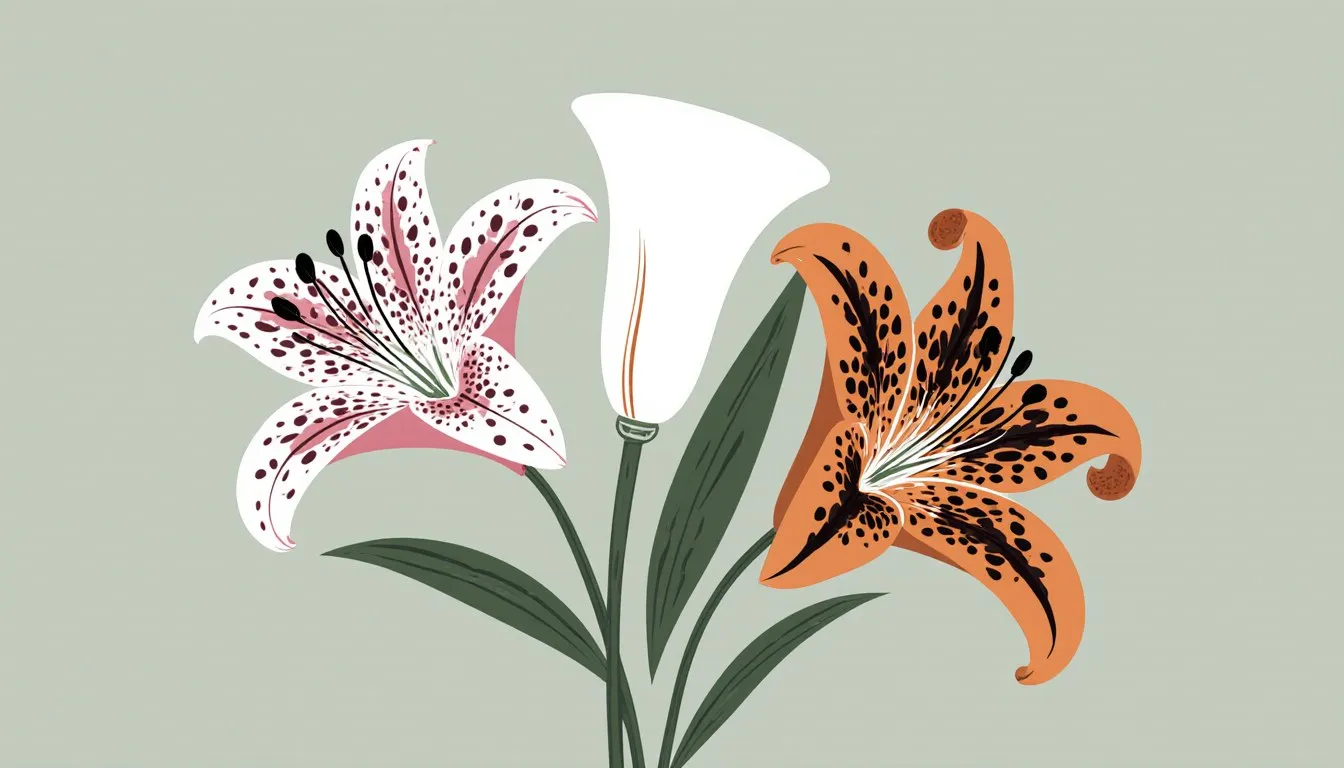
Stargazers are the ones with the big, flamboyant, magenta-and-white speckled blooms that face upward instead of drooping, which is actually where the name comes from, they look like they’re gazing at the stars. They symbolize ambition, prosperity, and celebration, and because of their bold color and scent, they’ve also picked up strong romantic and admiration meanings. If someone just got a promotion, hit a big milestone, or you want to say “I’m proud of you and also a little dazzled by you,” Stargazers are your flower.
White lily (Casablanca or Madonna): purity and sympathy
This is the classic funeral lily, and also the classic wedding lily, which tells you everything about how central “purity” is to its meaning. Casablanca lilies are large, pure white, and heavily fragrant. Madonna lilies are a bit more modest and are the variety most tied to the Virgin Mary in Christian iconography, hence the name. Either one says purity, virtue, and sympathy, and either one is genuinely lovely on an altar table or by a hospital bed. Context does the rest of the talking.
Tiger lily: confidence and wealth
Bright orange, freckled with dark spots, petals curled dramatically back. Tiger lilies symbolize confidence, positivity, and in some traditions, wealth and prosperity. In Chinese tradition specifically, tiger lilies have also been associated with wealth and abundance, which lines up with their bold, almost showy appearance. If you know someone who is unapologetically themselves, a tiger lily fits them better than a polite bouquet ever would.
Easter and Madonna lily: motherhood and virtue
Easter lilies (botanically Lilium longiflorum) are the trumpet-shaped white blooms you see stacked up in grocery stores every spring. Their meaning centers on purity, hope, and renewal, tied directly to that resurrection symbolism we covered above. They also carry a maternal thread, an echo of that original Hera myth, which is part of why lilies show up so often around Mother’s Day.
Calla lily: magnificent beauty and rebirth
Technically not a true lily at all (it’s in the genus Zantedeschia, a different family entirely), but calla lilies earned the name honestly with their elegant, single-petal, funnel-shaped blooms. They symbolize magnificent beauty and rebirth, and they’ve become one of the most popular wedding flowers going, especially for brides who want something sculptural rather than fluffy. I’ll be honest, if I had to pick one lily-adjacent flower for a bouquet on my own wedding day, it’d probably be this one. There’s something about that clean, single curve of a petal that photographs better than almost anything else in the flower world.
Day lily: motherly love and devotion, one day at a time
Day lilies (genus Hemerocallis, also not a true lily botanically, but close enough in spirit and appearance that nobody’s fighting about it at the garden center) bloom for exactly one day before wilting, and a new bud opens the next morning to take its place. That single detail shapes the whole meaning: day lilies symbolize motherly love and a kind of devotion that shows up fresh every single morning. If you garden, they’re also just wonderfully forgiving, which feels appropriate for a flower that’s basically a metaphor for showing up again tomorrow.
What do lilies mean in other cultures?
Western floriography isn’t the only system that gave lilies weight. In Chinese tradition, the lily, baihe, carries a beautiful bit of wordplay: the name sounds like the phrase for “a hundred years,” and lilies are traditionally given at weddings to wish the couple a hundred years of harmony and love together. That’s a genuinely lovely reason to reconsider a lily for a wedding gift if you’d previously written it off.
Lilies also carry motherhood symbolism in Chinese tradition, echoing that same maternal thread we saw in the Hera myth. It’s worth noticing: two cultures with almost no historical overlap independently landed on “this flower means devoted motherly love.” When symbolism shows up in more than one place without anyone comparing notes, that’s usually a sign the flower earned the meaning honestly, through how it actually looks and grows in the ground.
When is it actually a good idea to give someone lilies?
Basically, more often than you’ve been doing it. A few occasions where lilies genuinely shine:
- Weddings and anniversaries: Calla and Casablanca lilies for their elegance, or lean into the Chinese wedding tradition and give lilies specifically to wish a couple a long, harmonious marriage.
- New home: Day lilies or a mixed lily arrangement work well here, and day lilies are genuinely low-maintenance to plant as a housewarming gift that keeps giving. One real caveat first: lilies are seriously toxic to cats, every part of the plant, even the pollen and the vase water, so check whether there’s a cat in that home before you send any variety. The pollen also stains fabric and countertops on contact, so ask your florist to snip the anthers before delivery.
- Congratulations and big wins: Stargazers, no contest. Bold, celebratory, a little showy in the best way. They’re also the priciest lily on this list, budget for florist-arrangement money here, not a five-dollar grocery-store bunch. Save the grocery-bunch budget for the get-well flowers below, and save real splurging for wedding-scale calla orders.
- Get-well wishes: White lilies for a gentler, hope-forward message, though check first, some hospitals restrict strongly scented flowers on certain wards, so a quick call ahead saves everyone an awkward moment.
- New baby: Any variety leans on that motherhood thread nicely, but Madonna or Easter lilies carry it most directly.
And yes, sympathy is still a completely appropriate use, that association didn’t come from nowhere. If you’re specifically navigating a loss and want guidance on flowers for that moment, I’ve written a fuller guide to flower meanings around death with etiquette and arrangement advice I don’t have room for here. For everything else on this list, don’t let that one use case talk you out of the other nine.
Do lilies mean love, too?
They do, particularly the Stargazer. Its combination of boldness, fragrance, and upward-facing bloom has made it a genuine competitor to roses in romantic bouquets. Think anniversaries, or any “I’m serious about you” gesture. Pink and rose-colored lilies generally skew toward admiration and romantic affection as well. If romance is specifically your goal and you want the complete picture across every flower, not just lilies, I’ve put together a dedicated guide to flower meanings for love. But don’t sleep on a lily as a genuine rose alternative. It photographs beautifully, it lasts a good while in a vase, and it says something a little more distinctive than “here are roses” without saying anything less sincere.
A simple way to remember which lily to choose
You don’t need to memorize six varieties and their backstories every time you’re standing in a flower shop with fifteen seconds to decide. Here’s the shortcut I actually use: white means purity and sympathy, Stargazer means celebration and ambition, tiger means boldness and confidence, and day lily means everyday, ordinary love that shows up again tomorrow. Get that much right and you’ll rarely send the wrong message.
The thing worth carrying out of all this history is that a lily has always been a hopeful flower that got typecast as a sad one. Give it the other roles it’s earned.
Maya Ellison
Staff Writer
Maya Ellison writes about living a little better on an ordinary budget and an ordinary schedule: the small, doable changes that actually stick. She is a fan of the 20-minute version of everything and deeply suspicious of any wellness plan that requires a spare $400.