The Flowers That Actually Say Love, Beyond Roses
You’re standing under the fluorescent lights of the flower aisle, phone in one hand, a half-formed feeling in the other, and every bucket in front of you is roses. Red ones, mostly, because that’s what “love” defaults to when nobody’s thinking too hard about it. But what you’re actually trying to say is specific, and it’s yours. Maybe it’s brand-new and a little scared of itself. Maybe it’s thirty years old and still going. Maybe it’s not romantic at all, it’s for your best friend or your mom or, honestly, for you. A rose says one specific kind of love, the passionate, declared, “I choose you” kind. For everything else love actually is, there’s a whole vocabulary of flowers that’s been quietly doing this work for centuries, and once you know a handful of them, you’ll never grab the default bouquet again.
Why isn’t a rose always the right answer?
Roses became the shorthand for love because they’re genuinely good at one job: signaling romantic, often passionate love, the kind you’d put on a Valentine’s card. That’s not nothing. But it means a rose flattens every other shade of love into the same gesture. Give your grandmother roses on her fiftieth anniversary and you’ve said something true but oddly thin, like toasting a decades-long marriage with a first-date compliment.
This whole practice has a name: floriography. It’s the Victorian-era habit of assigning specific meanings to specific flowers, so a bouquet could carry a message too delicate, or too improper, to say out loud. It peaked in 19th-century England and France, when strict social codes made flowers a workaround for feelings that couldn’t be spoken plainly. Etiquette books and pocket dictionaries of flower meanings circulated so people could actually decode what arrived at their door. It was the same impulse as looking up an emoji’s meaning today when a friend sends one you don’t recognize. A lot of that vocabulary still holds today, mostly because florists and greeting card companies kept it alive long after the original etiquette rules faded.
I used to think this was all a bit precious, honestly, flowers as secret code feels like something out of a period drama. Then I actually needed to say something to someone I wasn’t ready to say out loud yet, and a bouquet of gardenias did the job better than I would have. That’s when the whole system stopped feeling decorative and started feeling useful.
If you want to go deep specifically on roses, what different colors mean, why a single stem says something different than a dozen, the full guide to rose flower meaning covers that in detail, and the broader rundown of flower meanings and symbolism is a good home base if you want the full map before narrowing in. What follows here is everything roses don’t cover: the other side of love’s vocabulary.
What flower means lasting, forever love?
For love that’s built to last, the flower with the most consistent history is the forget-me-not. Its name alone does most of the explaining: small, sky-blue clusters that have symbolized enduring love and remembrance since medieval Europe. Legend has it a knight died calling out the flower’s name to the woman he loved. It’s a lot of drama for such a small bloom, but I get why the story stuck. It shows up at weddings, in memory gardens, and increasingly in engagement bouquets for couples who want to say “this isn’t a phase” without spelling it out.
Myrtle is the quieter, more traditional choice, and if you’ve ever noticed a small sprig tucked into a royal wedding bouquet, that’s not decoration. Myrtle has been the marital love symbol in European bridal tradition for centuries, and it’s often grown from cuttings of the same original plant, generation after generation, which is its own kind of statement about love that outlasts a single lifetime.
Ivy carries a related but distinct meaning: fidelity. Because it clings and climbs, wrapping itself around whatever it’s near, it became shorthand for a bond that holds on. You’ll see it worked into wedding arches and anniversary arrangements for exactly that reason. None of these three are flashy. That’s sort of the point. A sprig of myrtle or a cluster of forget-me-nots says forever love the way it actually happens: quietly, and every day, without needing a spotlight.
If you’re shopping for a specific milestone rather than a general “still going strong” gesture, all three work as accents rather than the whole arrangement. A single myrtle sprig tucked into a larger bunch, or a small cluster of forget-me-nots at the base of a bouquet, does more symbolic work than swapping the entire arrangement for flowers most people won’t recognize on sight. Nobody needs to clock the reference for it to still mean something to the two of you.
What flower says “I’m falling for you”?
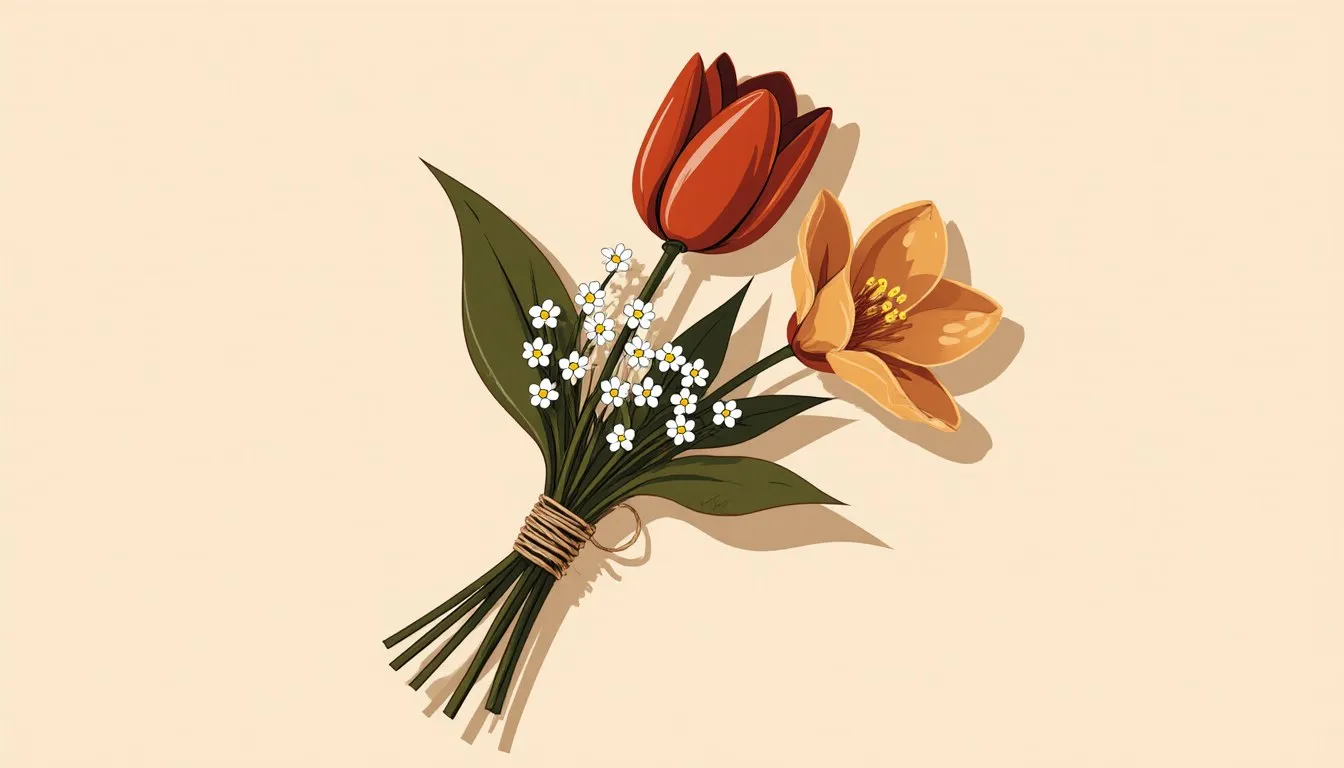
New, unsteady, exciting love has its own flowers. The classic is the tulip, specifically the red tulip. It has meant a genuine declaration of love in the language of flowers, and the meaning only deepened once tulip mania swept through the Netherlands. Unlike a rose, which can feel like it’s announcing a decision already made, a tulip reads a little more like a first draft: sincere, a little bold, still finding its footing.
Gardenias carry a softer, more secretive charge. Historically tied to secret or newly blooming love, a gardenia says something before you’re ready to say it out loud, the kind of feeling you’d hand someone without a card attached. Their heavy, sweet scent doesn’t hurt either; it’s memorable in a way that lingers past the moment you gave them.
Camellias sit in an interesting middle ground. A pink camellia leans toward longing and admiration, the flower equivalent of a crush you haven’t acted on yet, while lighter varieties skew toward simple admiration without the ache. If you’re somewhere between “I like you” and “I’m in love with you” and want the bouquet to sit honestly in that gap, camellias are built for exactly that ambiguity. I think that’s underrated. Not every feeling needs to be resolved before you hand someone flowers.
Is there a flower for complicated or unrequited love?
This is the corner of floriography most people never learn, because nobody’s rushing to buy flowers for a feeling that didn’t get returned. But it exists, and it’s oddly useful, both historically and as a way to process something without saying it directly to the person involved.
A yellow carnation, in Victorian flower language, meant rejection or disdain, about as blunt as this vocabulary gets. A striped carnation went further, historically used to signal “I cannot be with you” or outright refusal, which makes it one of the few flowers that was essentially a polite no. You wouldn’t hand either of these to someone today expecting warmth, but knowing the history explains why older novels and letters sometimes use “sending striped carnations” as a small, devastating gesture.
Acacia occupies gentler territory: secret love, the kind that’s never been spoken and maybe never will be. That’s a quiet, private ache, a feeling carried alone instead of announced. If you’re the type who processes things by writing them down rather than saying them out loud (I fully am), pairing acacia with a private note to yourself is a strange, small ritual worth trying. Nobody has to know what it means but you.
None of these are bouquet-for-a-crush flowers. They’re more interesting as a lens, a way to notice that the language of flowers always had room for love that didn’t work out, not just love that did. If you’re tempted to actually send one of these to make a point, I’d pump the brakes, a striped carnation reads as passive-aggressive to basically nobody who knows the reference and just confusing to everyone who doesn’t. This part of floriography is more fun as a history lesson than as an actual strategy.
What flowers say adoration and devotion instead of romance?
This corner of floriography runs on admiration, loyalty, and respect, not passion. Think sunflowers for the dad, peonies for the mentor, daffodils for the friend of thirty years. Sunflowers are the clearest match here: adoration and loyalty, tied partly to the plant’s habit of turning to follow the sun, which got read as a kind of devoted attention. A bouquet of sunflowers for your dad or your favorite teacher lands as warm and sincere without any romantic undertone at all, which is exactly the register you want for that relationship.
Peonies carry meanings of honor, romance, and good fortune. That sounds like a contradiction until you realize honor and admiration overlap more than pure passion does. Peonies are a traditional 12th-anniversary flower, but they also show up constantly in Mother’s Day arrangements, because “I honor you” and “I love you romantically” can both use the same lush, full bloom without confusion.
Daffodils are worth a mention too. Their meaning leans toward regard and new beginnings rather than romance, which makes them a genuinely good, low-pressure choice for a new mentor, a coworker you admire, or anyone where “love” needs to stay firmly in the respect lane. If you’ve ever felt weird giving someone flowers because you worried it would read as flirting, a daffodil bouquet solves that problem for you.
What about love that isn’t romantic, friendship and self-love?
Friendship has its own flower, and it’s underused: the zinnia, historically tied to thinking of an absent friend and to lasting affection between people who aren’t a couple. Bright, cheerful, and completely unromantic in tone, zinnias are a genuinely good “I appreciate you” gift for a friend going through something hard, or just because it’s Tuesday and you were thinking of them.
Self-love is trickier, mostly because Victorian floriography wasn’t built with “buy yourself flowers” in mind; that’s a much newer, more welcome habit. There isn’t a strict historical symbol for it the way there is for romantic or platonic love, and I’d rather tell you that honestly than invent one. What I’d actually say instead: pick whatever flower makes you happiest to look at on your kitchen counter. If you want a nod to tradition anyway, gerbera daisies lean toward cheerfulness and general good spirits, which is a reasonable stand-in for a “treat yourself” bouquet. But the real rule for self-love flowers is simpler than any of this vocabulary: buy the ones you’d actually stop and smile at.
How do you build a bouquet that says exactly what you mean?
Stick to two or three meaningful flowers, not ten, or the message turns into noise. A dozen different symbolic blooms crammed into one bunch just reads as a pretty arrangement, the specific message gets buried in the crowd.
A few combinations that actually layer well:
- Red tulip (declaration) plus forget-me-not (lasting love), for a new relationship you already sense is going somewhere.
- Sunflower plus peony, for a mother, mentor, or anyone you want to say “I admire and honor you” to without any romantic reading.
- Gardenia on its own, or paired with a single ivy sprig, for a new love you want to say is both exciting and something you intend to stick with.
- Zinnia in a bright, casual bunch, for a friend, no other flower needed to dilute the message.
One more thing worth checking before you buy: color changes the message as much as species does. A white flower and a red flower in the same species can mean almost opposite things, purity versus passion, sympathy versus celebration. If you want the fuller picture on how shade shifts meaning across species, flower meanings by color is worth a look before you commit to a specific bunch. It’s a five-minute check that can save you from accidentally sending mixed signals.
And don’t overthink the price tag here. A meaningful bouquet doesn’t require rare stems. Forget-me-nots, zinnias, and daffodils are all inexpensive, easy-to-find flowers at most grocery store florist counters. Tulips run a little more depending on season. Peonies have a short bloom window in spring, so they tend to cost more when they’re out of season or need to be shipped in. The symbolism doesn’t scale with the price. A three-dollar bunch of zinnias says exactly as much as a fifty-dollar arrangement, as long as you picked it on purpose.
One last practical note: if a specific flower on this list isn’t in season or your grocery store florist doesn’t carry it, ask. A lot of counters can special-order a handful of stems even if they don’t stock them regularly, and most florists genuinely like it when you show up knowing exactly what you want and why. Tell them the occasion and the meaning you’re going for, not just a color, and you’ll usually get a better arrangement than if you’d just pointed at whatever looked nice from across the shop.
Quick reference: which flower for which kind of love?
If you just want the cheat sheet to screenshot before your next flower run, here it is:
- Forget-me-not: enduring love, remembrance
- Myrtle: traditional bridal and marital love
- Ivy: fidelity, a bond that holds on
- Tulip (red): a declaration of love, new and sincere
- Gardenia: secret or newly blooming love
- Camellia (pink): longing, admiration, an unresolved crush
- Carnation (yellow): rejection, disdain
- Carnation (striped): refusal, “I cannot be with you”
- Acacia: secret, unspoken love
- Sunflower: adoration, loyalty
- Peony: honor, romance, good fortune
- Daffodil: regard, new beginnings, low-pressure admiration
- Zinnia: friendship, thinking of an absent friend
- Gerbera daisy: cheerfulness, a reasonable stand-in for self-love
Keep this list handy, or save it somewhere you’ll actually find it again, because the next time you’re standing in that aisle trying to say something specific, you won’t need to default to the dozen red roses out of habit. You’ll know exactly which bucket to walk toward instead. And if roses are still the right call for what you’re feeling, that’s worth knowing too, once you’ve actually ruled out the alternatives on purpose instead of by default.
Maya Ellison
Staff Writer
Maya Ellison writes about living a little better on an ordinary budget and an ordinary schedule: the small, doable changes that actually stick. She is a fan of the 20-minute version of everything and deeply suspicious of any wellness plan that requires a spare $400.