Desk Exercises for Your Core, Sorted by How Visible They Are
You’ve got eleven minutes before the next call, you’ve been sitting since 8am, and your abs have not been consulted about any of this. Here’s the honest answer: yes, you can work your core at your desk, chair-based moves that brace and squeeze your abdominal muscles do count as real activation. Three minutes of bracing between calls keeps the muscles around your spine switched on, eases some of the ache that builds from sitting still, and takes almost nothing out of your day. What it doesn’t do is build strength or get your heart rate up the way an actual workout does.
What desk exercises are genuinely good for is fighting the specific damage of sitting still for eight hours: the low-grade back ache, the core that’s gone quiet from disuse, the feeling that your midsection has clocked out along with the rest of you. A few minutes of seated core work, done a few times across the day, keeps those muscles switched on. People who stick with it generally notice sitting for long stretches feels a bit less stiff, and standing up out of the chair feels a little easier, even though it’s never going to hand you a six-pack.
Can you really work your core sitting at a desk?
Yes, in a limited but real way. Your core is made up of several muscles: the rectus abdominis you see in a mirror, the transverse abdominis, a deep, corset-like muscle that wraps around your midsection and stabilizes your spine, and the obliques along your sides. All three respond well to isometric work: bracing, holding, squeezing without moving much. That’s exactly the kind of exercise a desk chair is good for, since a desk chair is terrible at literally everything else fitness-related.
The catch, and I think it’s worth saying plainly instead of burying it under a bunch of “just five minutes a day!” enthusiasm, is that seated core work won’t do much for your heart rate, and only builds strength within the narrow range of motion you actually hold. Total daily movement and total time spent sitting still are two different measures, and desk exercises barely register on the first one. What they do is break up the second one, interrupting the stretch of stillness itself. A brace or a twist won’t get your heart rate up or offset a day of sitting the way a walk or a real workout would, but it will keep the muscles around your spine from going completely slack for eight straight hours.
So the realistic pitch is this: a few desk core moves make the hours you’re stuck sitting a little less bad for you, and they keep the muscles that support your spine from going dormant. I’d rather tell you that plainly now than have you feel let down by minute six of your first attempt, expecting it to feel like a workout when it’s really more like stretching your legs on a long flight.
What are the best desk exercises for your abs and core?
Pick two or three of these rather than trying to do all six every time. None of them require standing up, changing clothes, or explaining yourself to anyone, which is exactly why they’re easy to keep doing past the first week, when the novelty wears off and you’re back to just wanting to get through your inbox. Repeating a small set is what makes any of this stick, however modest it looks on day one.
Seated knee tucks
Scoot slightly forward in your chair so your back isn’t resting against it. Hold the sides of the seat for stability, lean back a few inches, and lift one knee toward your chest, then switch. Keep it slow and controlled rather than bouncy, this is one you’ll want to save for when you’re not mid-video-call, since it involves visibly rocking in your seat. Ten to twelve reps per side is plenty to feel your lower abs working. If your lower back complains, ease up on the lean, and check with a healthcare professional if it persists. If you’re pregnant or recently postpartum, run the knee tucks and the twisting moves past your provider before adding them. There’s no prize for the deepest lean.
Seated bicycle twists
Same starting position as the knee tuck, but bring your right elbow toward your left knee as it lifts, then alternate sides. This is the desk version of a bicycle crunch, and it’s the one that most directly targets your obliques, the muscles along your waist that rotate your torso. Go slow, twisting fast just turns it into fidgeting and you’ll feel it in your neck before you feel it in your core. It’s also the one that looks the most like exercise from across the room, so treat it as an after-lunch-walk move rather than a mid-meeting one.
Chair plank (or chair hover)
Place both hands on the edge of your seat or armrests, feet flat, and press down to lift your hips slightly off the chair, holding your body in a straight line for a few seconds before lowering. This is the closest a desk move gets to a real plank, and it’s genuinely more demanding than it looks, your shoulders will know about it before your abs do. Start with three to five second holds and build from there. The first few attempts are often shakier than you’d expect, that’s just your stabilizers catching up to the new position.
Pelvic tilts
Sit tall, then gently tilt your pelvis forward and back, flattening and arching your lower back against the chair. It’s a tiny movement, almost invisible from across the room, and it asks so little that it’s an easy way to ease back into core work after time off. Do this one slowly, ten reps, and notice how much control it takes to keep it small. This is the lowest-effort move on the list, and a reasonable default on days when everything else feels like too much.
Seated torso twists
Cross your arms over your chest or place your hands behind your head, keep your hips facing forward, and rotate your upper body left, then right, pausing briefly at each side. This is a gentler cousin of the bicycle twist, lower effort and lower payoff, and a good way to practice the rotation pattern before you add the arm swing of the full twist. It asks very little of you, which is its own kind of value on a rough day.
Isometric ab braces
This is the one you can do while actually reading an email. Tighten your abdominal muscles as if someone’s about to poke you in the stomach, hold for ten to fifteen seconds, breathe normally through it, then release. Isometric bracing like this works the same muscles without any repeated movement, which is why it’s usually the exercise that shows up first in any seated core routine. It’s the least dramatic thing on this list, no visible movement, no rep count to lose track of, and it’s the one that’s easiest to actually stick with because you can do it anywhere, including in a meeting you’re only half paying attention to anyway.
Which desk core exercises are discreet enough for an open office?
For most people, the real obstacle here is the coworker two feet away who will absolutely notice if you start twisting around in your chair like you’re wringing out a towel. Open floor plans have killed a lot of good intentions this way. So here’s the split.
No one will notice these:
- Isometric ab braces, since they’re internal and invisible from the outside
- Pelvic tilts, which move your lower back by an inch, tops
- Seated torso twists, kept small and slow, especially if your desk hides your lap
Save these for when you step away, a private office, an empty conference room, or that stretch of afternoon when half the floor is at lunch:
- Chair plank, which lifts you visibly off the seat
- Seated knee tucks, which involve leaning back and moving your legs
- Seated bicycle twists, for the same reason, plus they tend to make your chair squeak
If your desk faces a wall or you’ve got a cubicle with any real height to it, you probably have more room than you think. If you’re at a long open table with sightlines in every direction, lean on the invisible three and save the bigger moves for a bathroom break or a walk to get water. Nobody has ever built a habit around feeling watched while they exercise, so work with your actual office instead of against it.
How often should you do desk exercises for it to actually add up?
Short bursts, repeated, beat one long session. Two or three rounds a day, three to five minutes each, is a realistic target that doesn’t require you to block out your calendar or explain a mysterious recurring meeting called “core.” Set it to something you already do anyway: right after your 10am coffee, right before lunch, and once more in that dead zone around 3pm when your focus is shot regardless.
What matters more than the exact number is that it’s a pattern your day can hold. If you only manage one thing today, make it the isometric brace, it’s the lowest-friction option on the whole list and the easiest to remember when a meeting runs long and the rest of your plan quietly falls apart. But repetition is what actually adds up: a five-minute burst four days a week beats an ambitious fifteen-minute routine you do once and then feel guilty about for a month. Anchor it to something that already happens on autopilot, coffee, lunch, the 3pm slump, so you’re not relying on willpower to remember.
I’d also say: don’t chase soreness as proof it’s working. Seated core exercises are gentle by design. You’re not supposed to feel wrecked by them. The win is quieter, a spine that feels a little more supported by 5pm, a core that hasn’t spent eight straight hours doing nothing.
Do standing desks open up more options?
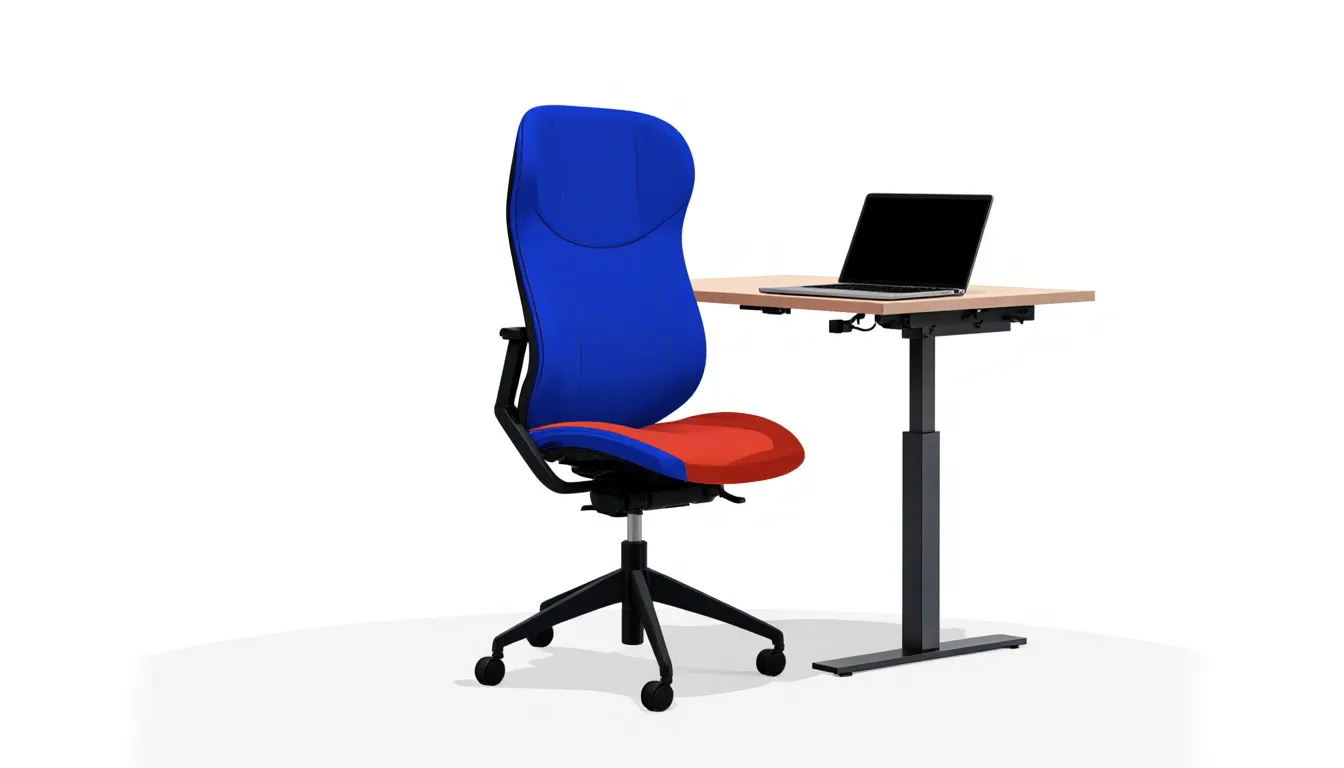
If you’ve got a standing or adjustable desk, yes, and it’s worth using that extra range while you have it. Quick heads up on cost, since it’s the one genuinely pricey item in this whole article: a basic converter that sits on top of an existing desk starts around $100 to $150, while a proper electric sit-stand desk usually runs a few hundred dollars and climbs from there. If you’ve already got one, none of this costs you anything extra, so it’s worth actually using it instead of leaving it parked at sitting height out of habit. And if a standing desk isn’t in the cards right now, you’re not missing much: everything in the seated list above works the same muscles without costing you a cent.
- Standing plank against the desk: step back a couple feet, place your forearms on the desk surface, and hold your body in a straight diagonal line. It’s a genuine plank variation, easier on your wrists than a floor plank, and much harder to fake than the seated version, your legs will be shaking before your abs give out.
- Standing torso twists: feet hip-width apart, rotate your upper body side to side with more range than you’d get sitting down, since your hips are free to help instead of being pinned by a chair. This one wakes you up in a way the seated version just doesn’t.
- Standing marches with a twist: lift one knee and bring the opposite elbow to meet it, alternating sides. It engages your obliques and gets a small amount of your heart rate up too, which none of the seated moves really do. It’s also the one that makes you look like you’re actually working out, so save it for when you’re not on camera.
None of these require leaving your spot, but they do use more of your body than anything a chair allows, which is really the whole case for spending the money on a standing desk in the first place. If yours has been sitting at the same height since 2023, and your legs are going to be tired by 4pm either way, this is as good a reason as any to actually raise it for twenty minutes.
Are desk exercises enough, or just a starting point?
Just a starting point, and I’d rather tell you that straight than let you think five minutes of seated twists is squaring you up with your body for the day. Desk exercises get you a slightly more engaged core and a spine that isn’t completely neglected, real, if modest, damage control for a day spent sitting. Building actual strength or stamina still takes a real workout. That’s a real, worthwhile thing on its own, even on a day when it’s all you manage.
If you’re looking to actually build a routine, rather than just soften the effects of the one you’re stuck in at work, there’s a whole guide to the main types of exercise, strength training, cardio, lower-impact options, and how to choose between them. And if what you’re really craving is something that gets you off the chair entirely and moving with intention, even for fifteen minutes, a guide to yoga for beginners is a genuinely gentle way in, no equipment required beyond a bit of floor space.
For now, though, don’t let the bigger picture talk you out of the small one. A brace here, a twist there, done consistently across a week you didn’t have time to plan around, adds up to something real, even if it’s not the whole workout you’ll eventually want. That’s enough for today.
This is general wellness information, not medical advice. Talk to a healthcare professional about your specific situation, especially if you have an existing back or abdominal condition, before starting a new exercise routine.
Maya Ellison
Staff Writer
Maya Ellison writes about living a little better on an ordinary budget and an ordinary schedule: the small, doable changes that actually stick. She is a fan of the 20-minute version of everything and deeply suspicious of any wellness plan that requires a spare $400.