Aquarium Setup and Care: The Weeks Between Filling the Tank and Adding Fish
A freshwater tank is ready for fish roughly four to six weeks after you fill it, not the afternoon you carry it home. In that gap, the water has to grow a bacterial colony big enough to handle the waste the fish will produce, and there is no shortcut that reliably compresses it into a single Saturday. Everything else in aquarium setup and care, the tank, the filter, the heater, the gravel, the weekly bucket, exists to support that colony.
My first tank died on a Tuesday, nine days after I set it up. Ten gallons, six fish added the same day I filled it, and I could not understand why a tank that looked fine on Sunday had fish hanging at the surface by Thursday. The store had sold me a tank, fish, food and a net in one transaction. Nobody mentioned that the water itself was not finished. This is the order I wish someone had given me, and what the tank asks of you every week once it is running.
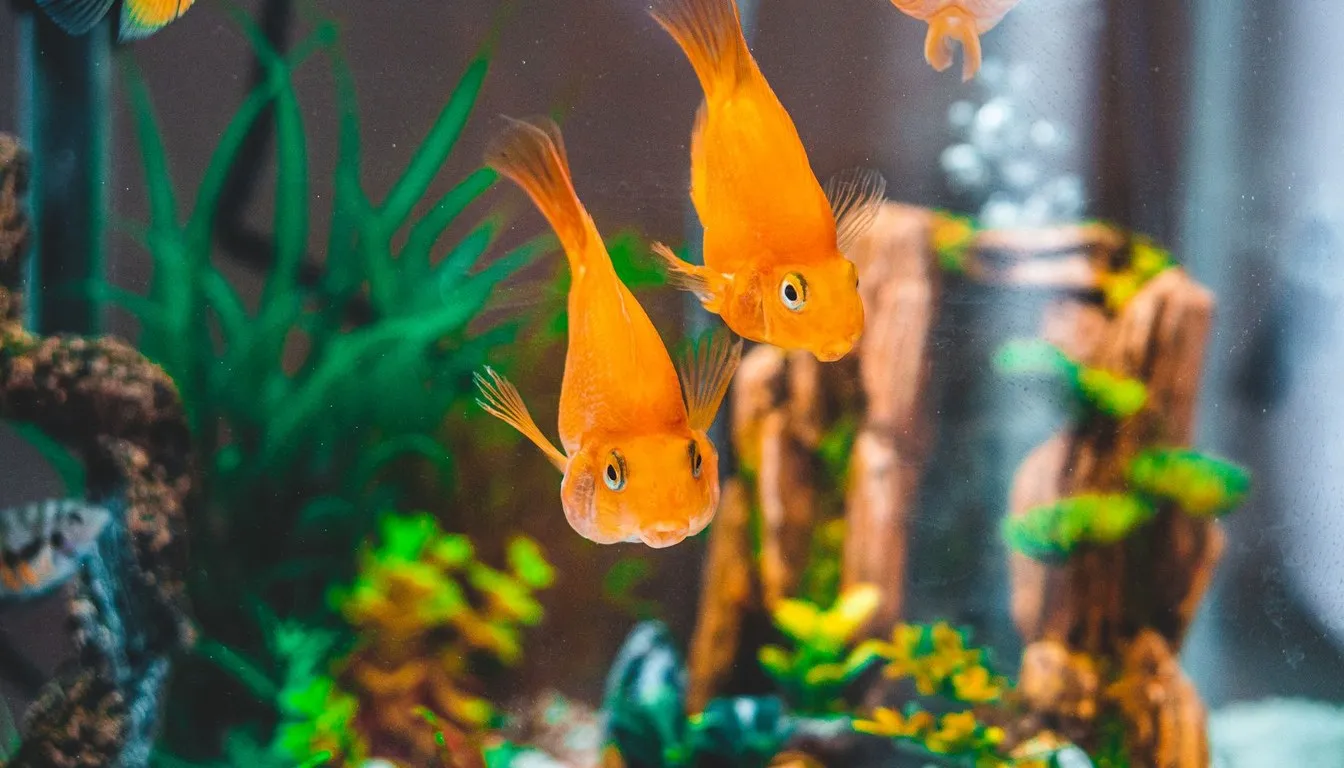
Here is the bill up front. A tank is twenty to thirty minutes of hands-on work every week for as long as it runs: a bucket, a siphon, a glass wipe, a look at every fish. Setting up a 20-gallon freshwater tank properly costs about $150 to $250, then $50 to $90 a year in food, dechlorinator, test reagents and electricity. And the animals stay: guppies a couple of years, a betta three or four in good conditions, corydoras and most common community fish five years and up, and a goldfish potentially decades in a tank big enough to deserve it. The month of cycling described below is the shortest commitment in this article.
What does a new tank need before any fish go in it?
It needs to be set up, running, warm, and left alone with a source of ammonia for about a month while bacteria colonise the filter. That is the whole answer, and it is the part the checkout line skips.
Physically, the setup is a single afternoon. You rinse the substrate until the water running off it is clear (gravel dust will turn a new tank into grey soup for days if you skip this), position the tank on a stand that can carry the weight, add substrate, hardscape and plants, fill it with dechlorinated tap water, and plug in the filter, heater and light. By evening it looks like an aquarium. It photographs beautifully. It is also, biologically, a bucket of water with a pump in it.
What is missing is a population of nitrifying bacteria living in the filter media and on every surface in the tank. Those bacteria eat the ammonia that fish excrete through their gills and that uneaten food releases as it breaks down. Without them, ammonia climbs in a straight line from the moment the first fish goes in, and ammonia burns gills at concentrations too low to see, smell or guess at.
So the honest sequence is: build the tank, run the equipment, feed the bacteria, test the water until the numbers prove the colony is established, and only then buy fish. The fish are the last thing you purchase, and by then you will have owned the tank for a month. Every keeper I know who lost a first tank lost it by inverting those last two steps.
How do you pick the right tank size and spot for it?
Buy the biggest tank your floor, budget and patience will carry, because a large volume of water dilutes every mistake you are going to make in your first year. This is the single most counterintuitive thing about the hobby, and it costs beginners more fish than any other misunderstanding.
The logic is dilution. In a small tank, one dead snail behind a rock, one overfeeding, one heater that sticks on, and the whole water column swings before you notice. The same mistake in a larger tank gets diluted into something the bacteria can absorb while you catch it. Temperature behaves the same way: a bigger body of water cools and heats slowly, so a chilly night or a sunny window moves the thermometer less. A tank in the 20 to 29 gallon range is a much easier first tank than a 5, even though the 5 looks like the beginner option on the shelf.
Weight decides the location. Water alone runs about 8.3 pounds per US gallon, so a 20-gallon tank with substrate and glass is comfortably over 200 pounds standing on a footprint the size of a large suitcase. That goes on a purpose-built stand or a piece of furniture rated for it, not a bookshelf, and ideally against a load-bearing wall rather than the middle of an upstairs room. Keep it out of direct sunlight (algae) and away from radiators, doorways and speakers. You also want a power outlet within reach and floor space for a bucket, because you will be standing there with one every week for as long as you own it.
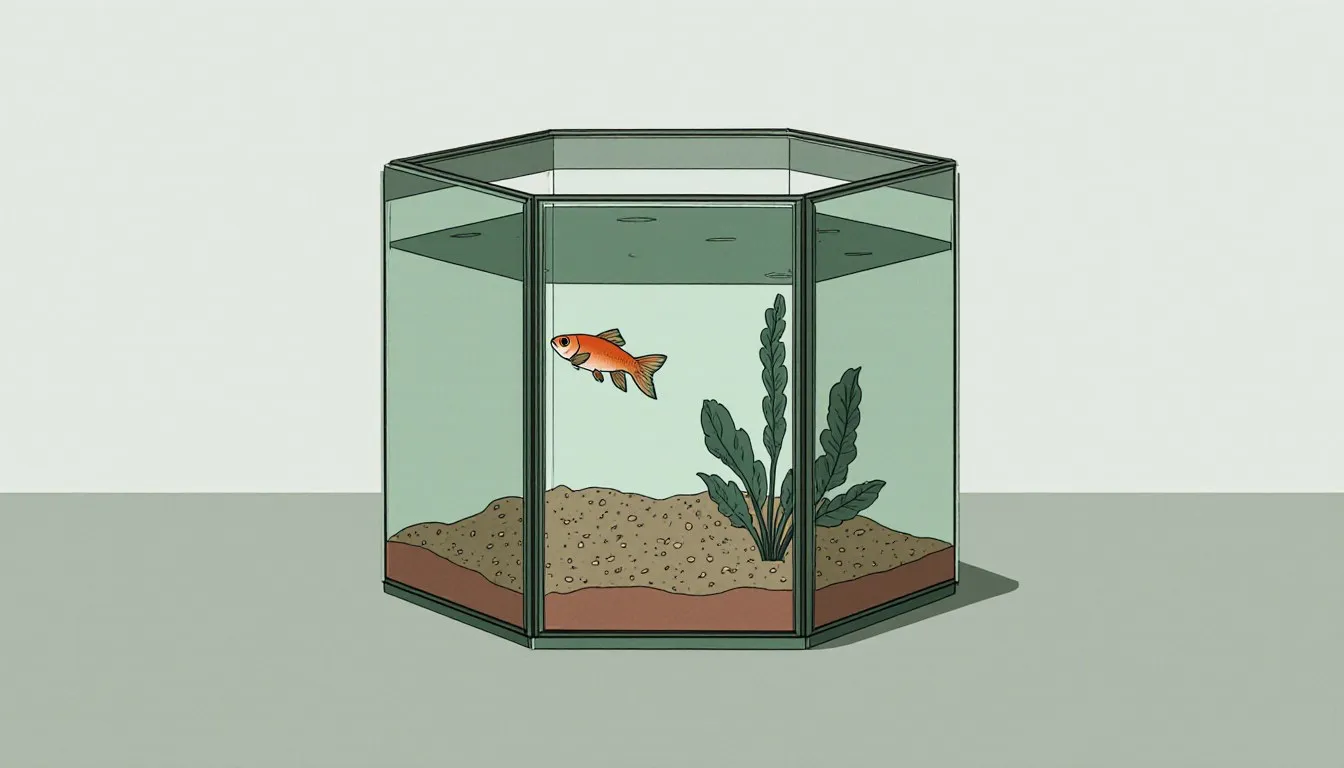
Glass is heavier, cheaper in standard sizes, and shrugs off the scraping you will do to clear algae. Acrylic is lighter and clearer but scratches if you look at it wrong, and a single careless pass with a gravel-caught magnet cleaner leaves a permanent smear. Shape matters as much as volume: long, low tanks give you more surface area for gas exchange and more swimming length than tall narrow ones of the same capacity, which is worth knowing before a hexagon fish tank catches your eye on a shelf. If you want to work out how many fish a given footprint will genuinely support, fish tank sizes goes through the stocking maths properly.
What equipment does an aquarium need, and what can wait?
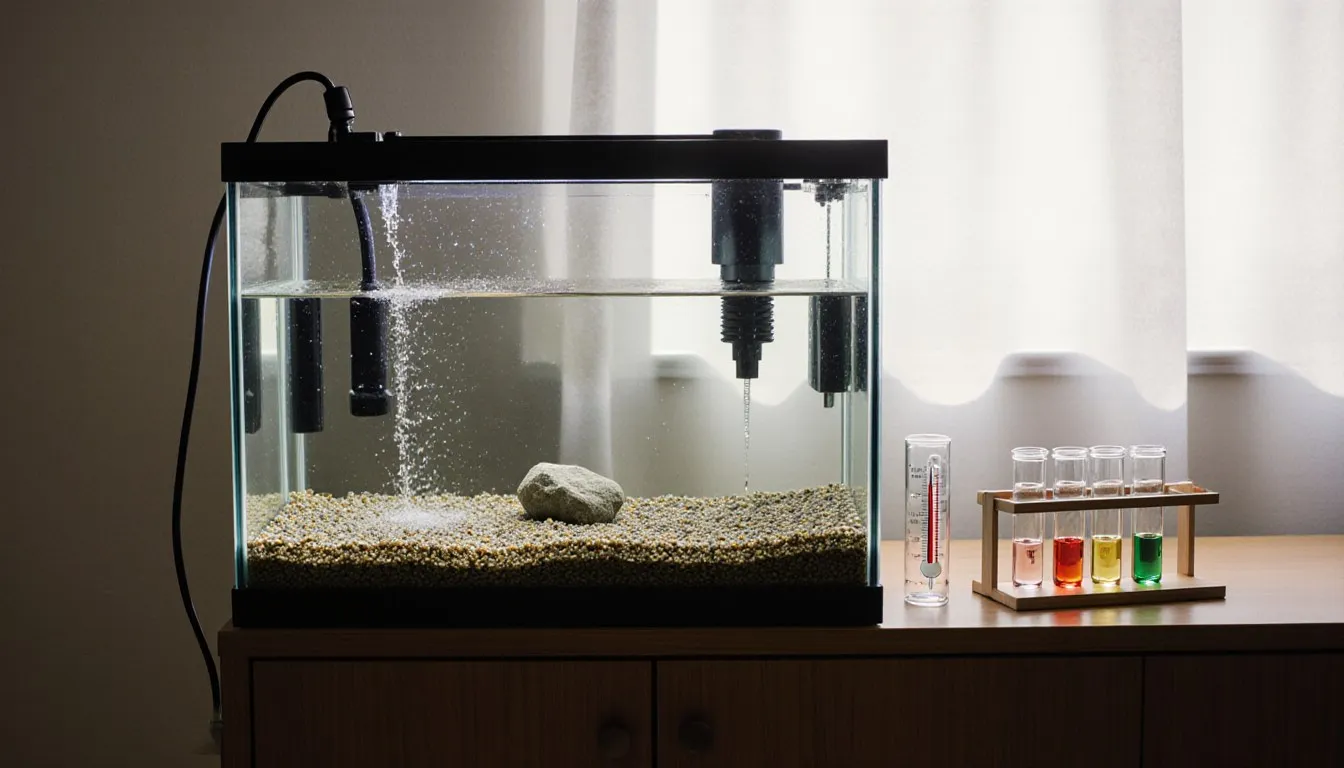
Five things do real work: a filter, a heater, a thermometer, a light, and substrate. Almost everything else in the aisle is optional, and one of the five gets skipped constantly.
- Filter: it does three jobs. Mechanical filtration traps floating debris in sponge or floss. Biological filtration houses the nitrifying bacteria on porous media, which is the job that actually keeps fish alive. Chemical filtration, usually activated carbon, pulls dissolved compounds and odours out of the water. Hang-on-back filters suit most first tanks; sponge filters driven by an air pump are cheap, gentle and superb for quarantine and fry; canisters make sense on larger setups. Size it for your tank or slightly above.
- Heater: tropical freshwater fish want stable water in roughly the 75 to 80°F range (about 24 to 27°C), and stability matters more than the exact figure. An unheated room-temperature tank swings several degrees a day, and that chronic stress is what softens fish up for everything else.
- Thermometer: the piece everyone skips. Heater dials lie, sometimes by several degrees, and heaters fail stuck-on far more often than people expect. A cheap glass thermometer at the opposite end of the tank from the heater is the only way you will know. Mine has caught two failing heaters in fifteen years.
- Light: fish do not need much, plants do, and algae will take whatever you give it. Put the light on a timer and run a fixed photoperiod. Freehanding it is how you end up with green glass.
- Substrate: gravel or sand, chosen by which fish will be sitting on it. Bottom-dwellers like corydoras catfish need sand or smooth rounded gravel, because sharp substrate wears their barbels down over months.
Two consumables are not optional either. A dechlorinator, because chlorine and chloramine in tap water kill the bacteria you spent a month growing and irritate gills, and a liquid test kit for ammonia, nitrite, nitrate and pH. Paper strips are convenient and vague. The liquid kits take five minutes and give you numbers you can actually act on, and during cycling those numbers are the only thing telling you what is happening. Add a lid: fish jump, and the ones that jump hardest are often the ones sold as calm.
What is the nitrogen cycle, and why can’t you skip it?
The nitrogen cycle is the bacterial chain that turns fish waste into something far less toxic. Fish excrete ammonia. One group of bacteria converts ammonia into nitrite. A second group converts nitrite into nitrate. You then remove nitrate with water changes. Ammonia and nitrite both harm fish at concentrations low enough that only a test kit will show them, long before the water looks or smells any different. Nitrate is tolerated at far higher levels, which is what makes the chain worth having.
Those bacteria are not floating in the water. They live as a film on surfaces, overwhelmingly inside the filter media, and they multiply slowly compared to almost anything else in the tank. A colony large enough to process the waste of a stocked aquarium takes weeks to build, and it only grows to the size its food supply supports. This is why the colony has to be fed something before there are fish, and why it shrinks if you strip the tank down.
Cycling with fish already in the tank means the fish themselves supply the ammonia, and they sit in it while the bacteria catch up. In practice that is one to two weeks of measurable ammonia, then a nitrite spike that is often worse, all of it happening across the gills of an animal that cannot leave. Survivors frequently carry the damage. The pet trade did this for decades and called the losses “new tank syndrome”, a name that makes a scheduled ammonia poisoning sound like weather.
Fishless cycling produces the same colony with nobody breathing the ammonia. It costs you patience and nothing else, which is the best trade in the hobby.
How do you cycle a new aquarium step by step?
You dose the empty, running tank with ammonia, test it every couple of days, and wait for the tank to prove it can clear a full dose overnight. Expect four to six weeks, faster if you can beg seeded filter media from an established tank.
- Set the tank up completely and run it. Filter on, heater on, temperature at your target. Warmth speeds the bacteria up considerably, so cycle at the temperature you intend to keep, not at room temperature.
- Add an ammonia source. Pure household ammonia with no detergents, surfactants or perfumes is the cleanest option: dose to a few parts per million and record how much you added. Bottled ammonium chloride sold for the purpose is easier to measure. The old method of dropping in a pinch of fish food and letting it rot works too, but it fouls the water and gives you no control over the dose.
- Test every two or three days. Ammonia climbs first. After a week or two, nitrite appears and ammonia starts falling. Then nitrite falls and nitrate appears. Watching those three curves cross is the only genuinely interesting part of a month of waiting, and it is worth writing the numbers on a sheet taped to the wall, because memory smooths them out.
- Re-dose ammonia each time it hits zero. Starving the colony halfway through sets you back. Keep feeding it at the level you dosed initially.
- Confirm the cycle. The tank is cycled when a full dose of ammonia reads zero ammonia and zero nitrite within 24 hours, with nitrate present. Not “close to zero”. Zero on both, twice in a row, before anything with a spine goes in.
- Do a large water change. Nitrate will be high by the end. Change enough water to bring it down, match temperature, dechlorinate, and then add your first small group of fish.
Two accelerants genuinely work. A used filter sponge, a handful of gravel or a bag of ceramic media from a healthy established tank carries live bacteria and can cut weeks off the timeline; keep it wet and in the tank within a couple of hours of collecting it. Bottled bacteria products vary enormously in whether they contain live, correct species, and the honest position is that some keepers get a fast cycle from them and others get nothing but a bottle. Either way, you still test every couple of days, whatever the bottle promises on the front, because the only evidence a colony exists is a dose of ammonia reading zero the next morning.
Plants help too. A heavily planted tank uses ammonia directly and can carry a light stocking earlier, though I would still cycle it properly rather than trusting a handful of stems to do a filter’s job.
Which fish belong in a brand-new tank?
Start with a small group of hardy, small, non-territorial fish, and add them in batches over months rather than all at once. A cycled tank is cycled for the bioload you fed it, and dumping fifteen fish into a colony grown on a few parts per million of ammonia will spike a “finished” tank overnight.
Solid first choices are guppies, platies, zebra danios, white cloud mountain minnows and corydoras catfish. All of them tolerate a range of conditions, eat readily, and behave visibly enough that you notice when something is wrong. Neon tetras are the classic beginner fish and are lovely in a group of ten or more, but they are mass-bred at volume and often arrive fragile, so I would give a new tank a few months of stability before adding them. Corydoras need company (six or more of the same species) and a soft floor. A betta is a fine first fish for someone who wants one animal with a personality, in a heated, filtered tank of five gallons or more, alone. The vase on the counter, unheated and unfiltered, is the reason bettas have a reputation for dying quickly.
Stocking is about adult size, waste output and behaviour, not the “inch of fish per gallon” rule, which treats a common pleco and ten neons as equivalent. Ask three questions before buying: how big does it get, does it need a group, and does it need to eat or fight anything already in the tank. That knocks out most of the classic first-tank disasters, the common pleco that outgrows the tank, the goldfish sold for a bowl when it needs a large heavy-load setup, the chinese algae eater that turns aggressive with age.
Add one small group, wait two to three weeks while testing, then add the next. If you can run a quarantine tank, a bare ten-gallon with a sponge filter and a heater, keep new arrivals in it for two to four weeks before they meet your established fish. It looks fussy right up to the first time it saves you an entire tank. And be aware that livebearers like guppies and platies will breed in your tank whether you planned for it or not, which is its own small education in how fish mate.
How much weekly work does a tank take?
About twenty to thirty minutes a week, most of it a bucket and a siphon, plus a couple of minutes a day watching the fish eat. That is the entire ongoing commitment for a well-stocked freshwater tank, and it does not end.
The weekly routine:
- Partial water change of 10 to 25 percent. Siphon from the substrate with a gravel vacuum so you pull out detritus while you remove water. Refill with temperature-matched, dechlorinated water poured gently onto a plate or your hand so you do not blast a crater in the gravel.
- Wipe the glass. Algae magnet or scraper before the film thickens. Two minutes now beats twenty later.
- Check the thermometer and look at every fish. Count them. Watch how they swim and whether everyone comes up to eat.
- Trim plants, remove anything dead. A decaying leaf or an unnoticed dead snail is a small ammonia source sitting in your tank.
Monthly, or whenever flow visibly drops, rinse the mechanical media. Do it in a bucket of water you just siphoned out of the tank, never under the tap, because chlorinated water kills the bacterial colony living in that sponge. This is the most common way people accidentally crash an established tank: they replace the whole cartridge every month because the box tells them to, throwing out most of their biological filtration each time. Squeeze the sponge until the tank water runs murky, put it back, and only replace media when it is physically falling apart, and then only one piece at a time.
Test the water weekly for the first couple of months, then monthly once the tank is settled, and always after a change of any kind: new fish, a dead fish, a filter swap, a holiday. In a mature tank ammonia and nitrite should read zero every time. Nitrate creeping up between water changes is normal and is exactly what the water change is for.
Feed once or twice a day, only what the fish clear in a couple of minutes. Overfeeding is the origin of more cloudy water, algae and ammonia trouble than any other single habit, and it happens because a fish begging at the glass looks starving at any hour of the day. They all do that. It is how they find food. A healthy adult fish missing a day is fine. A tank full of rotting flake is not.
What does an aquarium cost to set up and run?
Setting up a 20-gallon freshwater tank properly costs about $150 to $250, and running it costs $50 to $90 a year plus $15 to $40 of electricity. Those are the two numbers to plan around, and the second one never stops.
Tank size drives everything downstream, so gallons is the decision that sets both figures. A larger tank needs a stronger heater, more light, more filtration, more substrate, more dechlorinator per water change, and more electricity to keep warm. Going from a 20-gallon to a 55 roughly triples the substrate bill, takes the heater from about 100 watts to 250, and turns a 4-gallon weekly water change into 11 gallons of carrying.
Here is what my own tanks cost, in 2026 money, with the usual caveat that prices move with your country and your patience. A 20-gallon all-in starter kit (tank, hood, light, hang-on-back filter) runs about $80 to $130 new. Piecing it together costs a bit more and gets you gear worth keeping: a bare 20-gallon tank $30 to $50, a hang-on-back filter or a sponge filter with an air pump $15 to $40, a 100-watt heater $15 to $25, a glass thermometer $3, 20 pounds of gravel or sand $15 to $25, a lid $20, a gravel siphon $12, two buckets $8, and a liquid master test kit $30 to $35. Call it $150 to $250 for a setup you will not want to replace in a year. The stand is the wildcard: purpose-built is $80 to $150, and furniture you already own is free, provided it is genuinely rated for 250 pounds.
The recurring spend is smaller than people fear. A tub of decent flake or micro pellets costs $8 to $15 and lasts a lightly stocked tank three to six months. Dechlorinator is the cheapest thing in the hobby: a $10 bottle of the concentrated kind treats several hundred gallons and will see out the year. A liquid master kit is good for roughly 800 tests, so on a weekly-then-monthly schedule one kit covers two or three years, call it $15 a year in reagents. Sponges and floss come to a few dollars annually if you rinse them instead of binning them. That is $50 to $90 a year for one freshwater tank before any fish.
Electricity is the line everyone guesses at, so here is the arithmetic. A 100-watt heater on a 20-gallon tank in a room sitting around 68°F does not run continuously, it cycles, usually somewhere between 10 and 25 percent of the time, which is roughly 90 to 220 kWh a year, or about $15 to $40 at 17 cents per unit. Put the same tank in a cold hallway and both numbers climb. A modest LED on an eight-hour timer adds maybe 20 to 60 kWh a year, a small filter pump another 30 to 50. The fish are often the smallest line of all: guppies, platies and danios $3 to $6 each, corydoras $6 to $12, a good betta $10 to $25, so a fully stocked first community tank is frequently under $80 of livestock. Plants run from free (keepers give trimmings away constantly) to $15 a pot for whatever is fashionable this year.
Two levers move the total most. Filtration class is one: a sponge filter and an air pump cost a fraction of a canister and, on a modestly stocked tank, do the biological job perfectly well. Buying secondhand is the other, and a used tank and stand are frequently the single biggest saving available, provided you know what to inspect and how to leak-test before it lives on your floorboards, which buying a used aquarium walks through in detail. Skip the ornaments before you skip the test kit. Nobody has ever lost a tank to a plain background.
What goes wrong in a new tank, and how do you catch it early?
Most early trouble is water quality wearing a disguise, and most of it announces itself before the fish do. Watching the tank for five minutes at feeding time is the best diagnostic tool you own.
Cloudy white water in the first weeks is usually a bacterial bloom, harmless and self-resolving. It typically follows overfeeding or a disturbed substrate. Feed less, wait, resist the urge to fix it with a huge water change, which mostly just restarts the bloom.
Brown dusty film on glass and plants in a young tank is diatoms. Almost every new tank gets them, they wipe off easily, and they generally fade on their own as the tank matures. Green algae is a different conversation: it means light and nutrients exceed what the plants are using. Shorten the photoperiod, keep the tank out of the sun, and cut back on feeding before you buy anything in a bottle.
Fish hanging at the surface, gasping, is urgent. It usually means poor gas exchange or a spike in ammonia or nitrite, and warm water holds less oxygen than cool water, so summer makes it worse. Test immediately. In the meantime, increase surface movement, since gas exchange happens at the water’s surface rather than deep in the tank; how to aerate aquarium water covers the ways to do that properly.
Visible physical changes are worth acting on the same day you notice them. A bulging or protruding eye (keepers call it pop eye, and pop eye fish disease goes through what it looks like and what tends to sit behind it) and buoyancy problems where a fish floats, sinks or swims at an angle (the umbrella term is swim bladder disease) both have several possible causes, and both are commonly linked to water conditions that a test kit will show you in five minutes. Test the water first, every time, before you reach for any treatment.
Here is the boundary I hold as a keeper and not a veterinarian: husbandry is my lane, medicine is not. I can tell you to check ammonia, nitrite, temperature and feeding, to isolate an affected fish in a quarantine tank, and to clean up the conditions that stress fish in the first place. I cannot tell you what to dose. If a fish has an open wound or ulcer, if the eye is damaged rather than merely swollen, if several fish are affected at once, or if symptoms persist after the water tests clean, that is the point to contact a vet who sees fish. Bring your actual test numbers, the tank’s age, your stocking list and how long the symptoms have run. Aquatic vets are rarer than they should be, so it is worth finding one before you need one.
Freshwater, brackish, or saltwater: which fits a beginner?
Start freshwater. It has the cheapest equipment, the widest choice of forgiving fish, the simplest testing, and the shortest list of ways to go wrong, and every skill it teaches transfers directly to the other two.
Saltwater is not beyond a beginner’s ability, but it multiplies the variables. You are mixing salt to a specific gravity, testing more parameters more often, usually running live rock and a protein skimmer, and buying livestock where a single fish can cost more than a whole freshwater setup. The equipment budget climbs, and the margin for a forgotten water change narrows. Reef tanks add lighting demands and chemistry on top of that. Take it up after a freshwater tank has run for a year without surprising you.
Brackish sits between the two, both in salinity and in difficulty, and it is genuinely underrated. It suits species that spend their lives in estuaries where fresh water meets the sea, and it asks you to maintain a stable salinity with a hydrometer or refractometer rather than just topping up with tap water. The species are characterful and often unusual-looking, and the setups can be beautiful. It is worth the extra step once you can keep a freshwater tank stable without thinking about it, and brackish aquarium fish goes into which species earn the effort.
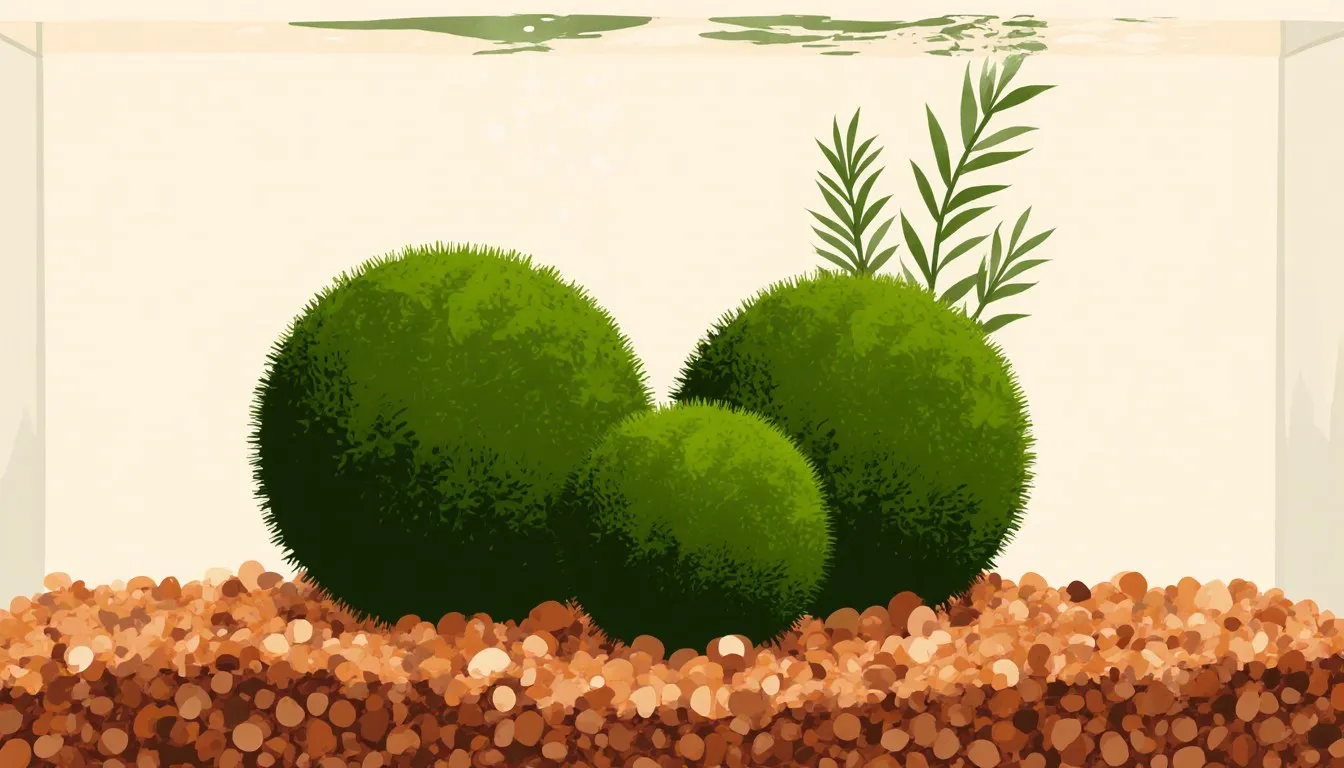
Whichever way you go, the freshwater year in front of you is not a waiting room. Learning to read a test kit, hold a temperature steady, and stock to adult size is the same work in all three, and the cheapest place to get it wrong is a tank of guppies. If you want a low-effort green addition while you are there, a marimo moss ball (a rolled ball of algae rather than moss) asks almost nothing and quietly uses nutrients; buy from a reputable source and inspect it, since an invasive-mussel contamination scare a few years ago put a lot of them under scrutiny, and marimo moss ball benefits covers what they do and do not achieve.
Who is aquarium keeping a good fit for?
It suits people who like small, regular, unglamorous routines and who can be interested in a process that takes a month before it does anything visible. If the appeal of a tank is that it will look finished on day one, this is the wrong hobby, and finding that out now is cheaper than finding it out through dead fish.
The honest commitment is a bucket of water every week for years, a filter that has to be maintained rather than replaced, holidays that need an automatic feeder or a friend with instructions, and a heater that will eventually fail at an inconvenient moment. The lifespans at the top of this piece are the real horizon: five years and up is ordinary for corydoras and most common community fish, and a well-kept goldfish can outlast the flat you bought it in. Plan for the far end of those numbers. The fish you carry home this month may still need a weekly bucket two moves and a job change from now.
It is a good fit for people who want a quiet animal to observe rather than handle, for households where a furred pet is not workable, and for anyone who finds the maintenance itself satisfying rather than a tax on the fun part. It is a poor fit as a child’s independent first pet, since the animal’s survival depends on a testing and water-change routine that an adult will realistically own. It is also a poor fit if you are moving in the next few months, because moving a tank means dismantling the bacterial colony and starting a version of the cycle again at the other end.
If you are still in, do it in the order above: tank and stand first, equipment running, ammonia in, four to six weeks of testing, then a small group of hardy fish. The weekly list earlier in this piece is the whole ongoing routine, and it is short enough to memorise by the third week. The tank you build slowly is the one that is still running in five years.